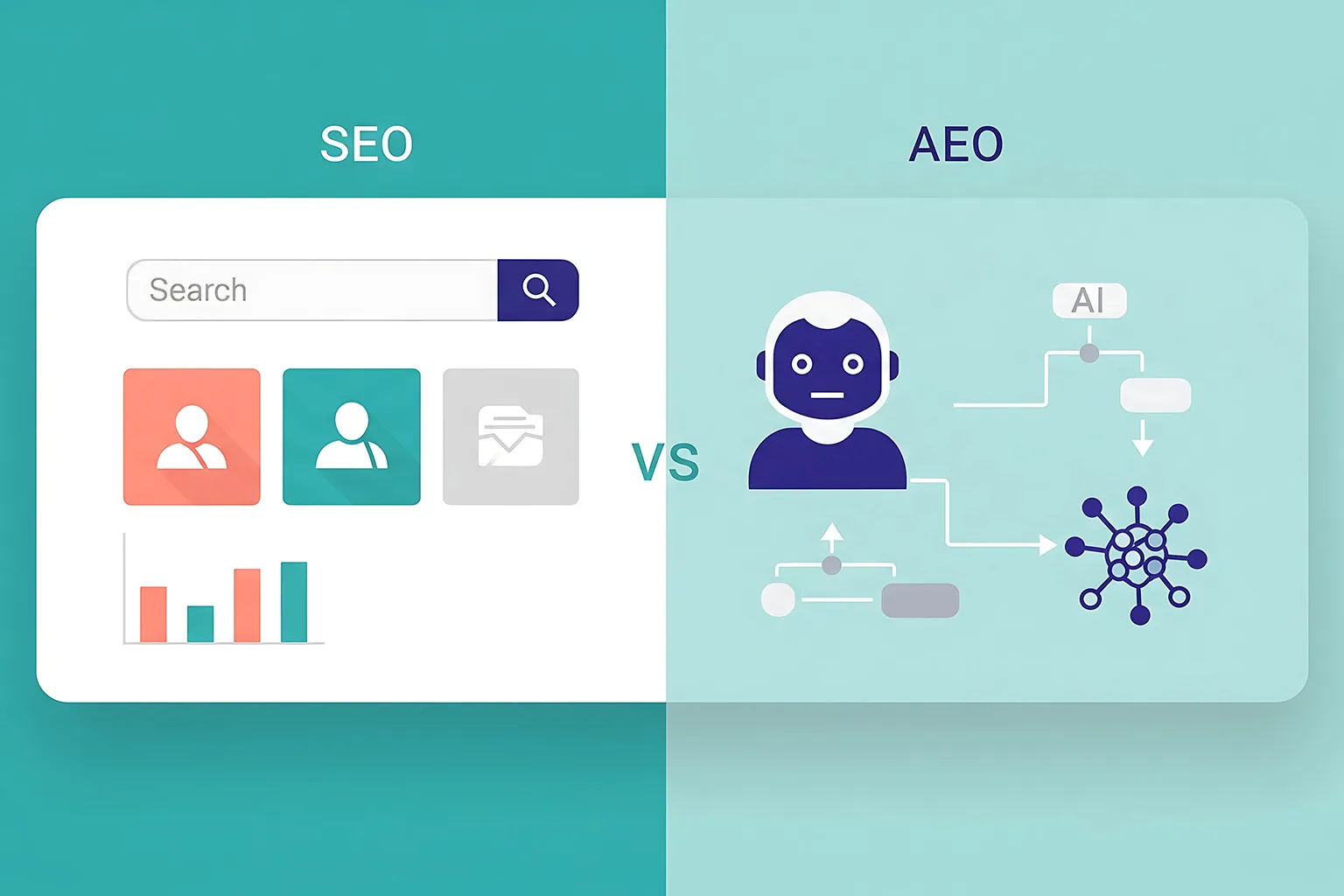
If you’ve noticed fewer people clicking blue links and more people getting instant answers from Google, ChatGPT, Siri, or Alexa—you’re not imagining things. Search has changed. And that’s exactly where AEO (Answer Engine Optimization) comes in.
Traditional SEO is still important, but AEO is about something slightly different: making sure your website is the source of the answer when people ask questions online.
Instead of just ranking for keywords, AEO focuses on clarity, structure, and context—so search engines and AI tools can quickly understand your content and confidently surface it as the answer.
AEO is the practice of designing and writing your website so answer engines can:
Think:
If your site isn’t structured to be understood, it’s unlikely to be chosen.
Here’s the shift we’re seeing every day:
AEO helps your website:
In short: If your website doesn’t answer questions clearly, someone else’s will.
This is where most sites fall short. AEO isn’t just about content—it’s about how that content is built.
Answer engines love websites that:
That’s why the platform your site is built on matters more than ever.
We build primarily in Webflow because it gives us complete control over the things answer engines care about most—without relying on plugins or duct-tape fixes.
1. Clean, Semantic Code
Webflow outputs lean, readable HTML that search engines and AI systems can easily parse and understand.
2. Precise Content Structure
We can intentionally design content around questions, answers, and hierarchy—no fighting with themes or bloated templates.
3. Built-In Speed & Performance
Fast-loading sites aren’t just good for users—they’re critical for visibility in AI-driven search results.
4. Easy Schema & Metadata Control
From FAQs to service pages, we can implement structured data cleanly and consistently.
5. No Plugin Dependency
Unlike many CMS platforms, Webflow doesn’t rely on third-party plugins that slow sites down or break updates.
6. Scales with AI Search Trends
As search evolves, Webflow gives us flexibility to adapt layouts, content blocks, and data structures without rebuilding from scratch.
The best AEO strategies combine:
It’s not about gaming the system—it’s about being genuinely helpful and making that helpfulness easy to recognize.
When your site clearly answers:
…answer engines take notice.
SEO gets people to your site.
AEO makes your site the answer.
If you’re investing in a new website—or rethinking an old one—this is the moment to design with answer engines in mind. Platforms like Webflow make that not only possible, but practical.
And the bonus?
AEO-friendly sites tend to be clearer, faster, and more enjoyable for real humans too.
Win-win.
Curious whether your current site is AEO-ready? We’re always happy to take a look and point you in the right direction.