Remember when finding a business online meant typing a few words into Google and scrolling through a bunch of websites?
Well, that's starting to change.
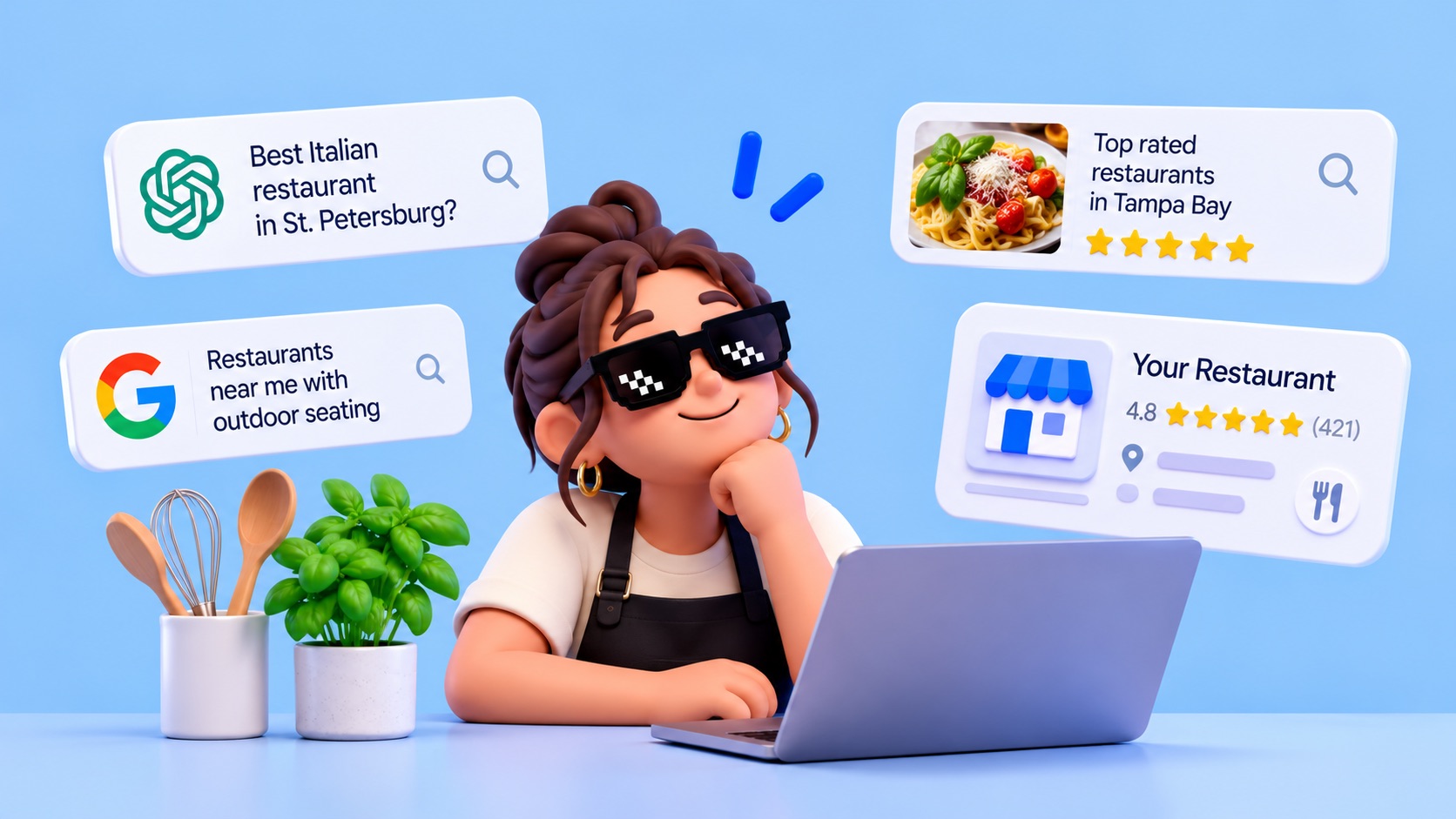
These days, people are asking ChatGPT, Google, and other AI tools to do some of the searching for them. Instead of looking through ten different websites, they might simply ask, "Can you recommend a good Italian Restaurant in St Pete?" or "Who's the best local company to help with my online store?"
And just like that, they've got a few suggestions.
Pretty convenient if you're the person searching. But what if you're the business owner and your company isn't one of those suggestions?
That's where things get interesting.
At RecMe, we've been spending a lot of time looking at how AI is changing the way people find businesses online. And one thing is becoming pretty clear: having a great-looking website is still important, but making sure it can actually be found and understood is just as important.
Let's talk about what that means, without getting too technical.
Traditional Google searches usually give you a list of websites to explore.
AI-powered search is a little different. You ask a question, and instead of just giving you links, it tries to put together an answer. Sometimes that answer includes business recommendations, helpful explanations, or links to websites it thinks are relevant.
For example, someone might ask:
"Who builds Shopify websites for small businesses in Tampa Bay?"
An AI tool might respond with a few companies, explain what they specialize in, and even suggest which one could be a good fit.
The interesting part is that the person searching might never make it to page two of Google. They might not even click through to a website until they've already narrowed down their choices.
So, how do you make sure your business has a chance of being included?
There's no magic button, unfortunately. But there are some things that can help.
This might sound a little silly, but it's surprisingly common.
We come across websites all the time with beautiful photography, clever headlines, and impressive animations. Everything looks fantastic.
But after a few minutes, we're still wondering what the company actually does.
Something like "Transforming Ideas Into Extraordinary Experiences" might sound wonderful, but it doesn't tell anyone whether you build websites, design kitchens, or organize corporate events.
And if people have trouble figuring it out, search engines and AI tools may struggle too.
You don't have to give up your personality or creative messaging. Just make sure that somewhere near the top of your website, you clearly explain what you offer, who you work with, and where you work.
Sometimes the simplest changes make a big difference.
Here's something you might not have heard of: structured data, also known as schema markup.
Sounds technical, right? It is a little, but the idea behind it is pretty straightforward.
Think of schema as a way of adding helpful labels behind the scenes of your website.
It can tell search engines things like your business name, where you're located, what services you offer, and which pages contain articles or products.
Visitors don't see these labels, but search engines can read them.
We add structured data to many of the websites we work on because it helps provide clearer information about the business and its content.
Will adding schema suddenly make ChatGPT recommend your company to everyone? No. We wish it were that simple.
But it does help create a better-organized website that search engines can understand, and that's a good thing regardless of how people are searching.
Here's one of our favorite ways to improve a website, and it doesn't require knowing anything about coding.
Think about the questions your customers ask you every day.
How much does your service cost? How long does a project take? What's the difference between two products? Do you work with businesses outside your local area?
Chances are, other people are asking those same questions online.
And that's exactly the kind of information AI search tools often try to find.
Let's say you own a small interior design business in St. Petersburg. Instead of having a website that only shows beautiful photos of completed projects, you could also explain how your design process works, what clients should expect, and how to prepare for their first consultation.
Or maybe you run an online store. You could help customers understand which products are right for them, how shipping works, or what makes your products different.
This is useful content. Real information that helps real people.
You don't need to publish a new blog post every other day or fill your website with hundreds of FAQs. Just start answering the questions that matter to your customers.
And please, write like a human. Nobody wants to read a page that sounds like it was written for a search engine.
Your website is important, but it's not the only place information about your business lives.
Google Business Profile, online directories, customer reviews, social media accounts, and mentions on other websites can all help establish who you are and what you do.
If your business has moved, changed its name, or updated its services, it's worth checking that the information floating around online is still accurate.
We see this quite often with businesses that have been around for a while.
Maybe an old directory still has your previous address. Or your Google Business Profile lists services you no longer offer.
It's worth tidying these things up.
For local businesses here in St. Petersburg and the wider Tampa Bay area, having an accurate, up-to-date online presence is especially important.
And while you're at it, don't forget about customer reviews. Genuine feedback from happy customers is valuable whether someone discovers you through Google, an AI tool, or a recommendation from a friend.
If you've been reading about AI search, you've probably come across a whole new collection of acronyms.
SEO, AEO, GEO, LLMs.txt. It's enough to make your head spin.
Here's the simple version.
SEO (Search Engine Optimization) is about helping your website get discovered through traditional search engines.
AEO (Answer Engine Optimization) focuses on making your content useful and understandable for systems that provide direct answers to questions.
GEO (Generative Engine Optimization) is a newer term for improving how your content can be discovered, referenced, or represented by generative AI systems.
And then there's LLMs.txt, a proposed file format that gives AI systems an organized overview of a website's important information.
We've been experimenting with LLMs.txt and other AI-readiness improvements on websites we build and manage.
It's an interesting development, although it's still early days. There's no solid evidence that simply adding an LLMs.txt file will make your website appear more often in AI search results.
The important thing to understand is that none of these are shortcuts.
You still need a website with useful content, a clear structure, and solid technical foundations.
Sometimes the problem isn't your content at all.
Your website might have technical issues that make it harder for search engines to access or understand certain pages.
Maybe an important page has accidentally been blocked from indexing. Perhaps your website is painfully slow on mobile. Or maybe some of your content isn't easy for automated systems to read.
These aren't always things you'd notice just by looking at your website.
That's why we think it's worth occasionally giving your website a proper checkup.
Not necessarily a complete redesign. Just a look under the hood to make sure everything is working the way it should.
You'd be surprised how often a few relatively small fixes can improve the overall health of a website.
You can certainly start looking.
Try opening ChatGPT, Google's AI search features, or Perplexity and asking the kinds of questions a potential customer might ask.
For example:
"Can you recommend a web design company in St. Petersburg, Florida?"
Or, if you're a local contractor:
"Who does kitchen renovations in St. Petersburg?"
See what comes back.
Just keep in mind that AI responses aren't always the same. Results can change depending on the question, the platform, your location, and other factors.
So don't panic if your business doesn't show up on the first try.
It's also worth looking at your website analytics to see whether you're getting visits referred from AI platforms.
Measuring AI search visibility is still evolving, but paying attention to how people discover your website is a good place to start.
Not even close.
People are still using Google every day, and traditional search results and Google Maps remain incredibly important for local businesses.
In fact, many of the things that help your website perform well in traditional search also help prepare it for AI-powered discovery.
Clear content. Helpful information. A well-organized website. Good technical SEO. A trustworthy online presence.
None of that has changed.
What's changing is how people find and use that information.
Rather than throwing out everything you know about SEO and starting again, think of AI search as another reason to make your website the best it can be.
There's a lot of noise around AI right now, and it's easy to feel like your business is falling behind if you're not doing something new every week.
But there's really no need to panic.
For most small businesses, the best place to start is with the website you already have.
Make sure it clearly explains what you do. Answer the questions your customers are asking. Keep your business information accurate. And check that everything is working properly behind the scenes.
Those are all sensible improvements, with or without AI.
Nobody can guarantee that ChatGPT or another AI tool will recommend your business. But you can make it easier for search systems to find, understand, and trust the information you publish.
And that's a pretty good place to start.
At RecMe, we're a small, creative web design and development studio based in St. Petersburg, Florida.
We build websites, solve technical problems, and help businesses make better use of the web. Lately, that also means helping our clients understand how AI is changing online search and what they can do to keep up.
Whether your website was built with Webflow, Shopify, Django, or something else entirely, there may be opportunities to make it more search-friendly.
And you don't need to become an AI expert to figure it all out.
Have a website you'd like us to take a look at?
Get in touch with RecMe. We'd be happy to chat about what's working, what could be better, and whether there's anything worth improving.
No complicated jargon. Just a friendly conversation about your website.